There are streets that are just streets. Places to walk, shop, maybe grab a bite. And then there are streets that carry the soul of an entire city. Malioboro Street is one of those rare places.
Most tourists know Malioboro as Yogyakarta’s famous shopping street where batik shops line both sides, street vendors sell everything from leather sandals to wayang puppets, and the smell of street food fills the air day and night. And yes, that’s all true. But what many don’t realize is that this 1 kilometer stretch of road is actually part of something much bigger and far more profound. The Cosmological Axis of Yogyakarta, a UNESCO World Heritage Site, is a 6 kilometer line that represents the journey of human existence itself.
In this complete guide, you’ll discover everything you need to know about Malioboro Street.
Before we get to the main stuff, just wanted to let you know – if you’re thinking about booking a tour around Yogyakarta, we’d love to help out. We’ve got some great reviews on TripAdvisor and Viator if you want to check those out. Here’s where you can see our tour packages: Yogyakarta Tour. And if Mount Bromo and Ijen Volcano are on your list, take a look at MountBromoIjen.com. Drop us an email at [email protected] anytime, or just hit the WhatsApp button over in the corner – whatever’s easier for you. Thank you for visiting BorobudurSunrise.com
Understanding the Cosmological Axis
Before we dive into shopping and street food, you need to understand what Malioboro Street actually represents. This isn’t tourism marketing. The Cosmological Axis has been a deliberate, sacred design since Sultan Hamengkubuwono I founded Yogyakarta in 1755.
The axis runs 6 kilometers from north to south. At the northern end sits Tugu Monument, marking the symbolic connection to Mount Merapi, the sacred active volcano. At the southern end, near Panggung Krapyak, the axis points toward the Indian Ocean and Parangkusumo Beach, home of Nyai Roro Kidul, the mystical Queen of the Southern Sea in Javanese legend.
The Kraton (Sultan’s Palace) sits at the absolute center, representing the Sultan’s role as anchor between earthly and spiritual realms. North of the palace is Alun Alun Utara (North Square). South of it is Alun Alun Kidul (South Square). And connecting the Kraton to Tugu Monument is Malioboro Street.
According to UNESCO’s inscription, the Cosmological Axis represents a sultanate capital designed to mirror the universe itself. The north south alignment connects the volcano’s power to the ocean’s depths, with the palace maintaining balance between these forces.
Here’s the interesting part: Malioboro represents the journey of human life. Starting near Yogyakarta Station at the north, you begin the journey. Walking south toward the Kraton, you’re symbolically moving through stages of human development toward wisdom and power.
Along this journey, you pass through commerce (shops and markets), community (gathering spaces), and eventually reach the three pillars: politics (Sultan’s Palace), religion (Masjid Gedhe), and economy (Beringharjo Market). Together they form Catur Tunggal in Javanese philosophy, the four pillars needed for a balanced, prosperous society.
Malioboro Street Today
Today’s Malioboro is a fascinating mix of deep philosophy and modern reality. The street stretches 1.5 kilometers from Yogyakarta Station in the north to Fort Vredeburg and the Kraton area in the south.
At street level, Malioboro is sensory overload in the best way. Both sides are lined with shops selling batik clothing, leather goods, traditional Javanese crafts, and souvenirs. Street vendors spread their wares on wide sidewalks with batik shirts on portable racks, wayang puppet figures, leather sandals and bags, and endless Jogja branded t-shirts.
The middle features a pedestrian promenade where becak (traditional pedicabs) and andong (horse drawn carriages) wait for passengers. You’ll also find local musicians performing, artists sketching portraits, and street performers entertaining crowds.
What makes Malioboro special is the energy. From early morning until late night, this street pulses with life. Indonesian families on vacation, backpackers comparing batik prices, local students hanging out, elderly couples strolling, becak drivers calling for customers, street food vendors grilling satay, and always the sound of motorbikes weaving through traffic.
The atmosphere changes throughout the day:
- Morning (6:00 AM to 10:00 AM): Relatively calm. Shops just opening, vendors setting up. Best time for photos without crowds.
- Midday (10:00 AM to 3:00 PM): Gets busy. Tour groups arrive, families shopping, tropical heat drives people to shaded areas. Peak shopping time with most selection but aggressive bargaining.
- Evening (4:00 PM to 9:00 PM): Transforms into something magical. Heat fades, street lights glow, food vendors come alive. Lesehan culture takes over (sitting on mats on the ground), with groups eating together and listening to live music.
- Late Night (9:00 PM to midnight): Different gathering place. Shops close but street food vendors stay busy. Jogja’s young people socialize and grab late night snacks. Vibe shifts from tourist focused to local focused.
Shopping on Malioboro Street
Let’s be honest. Most people come to Malioboro to shop. And you’ll find no shortage of options.
Batik Shopping
Batik is king on Malioboro. You’ll see it everywhere in every form imaginable. From cheap printed batik t shirts for 50,000 IDR to hand drawn batik tulis pieces worth millions of rupiah.
Hamzah Batik is probably the most famous batik shop on Malioboro. It’s a three story building that’s hard to miss. The owner is a bit of a local celebrity, known for his colorful personality. Inside, you’ll find an enormous selection ranging from casual batik shirts (around 120,000 IDR) to formal batik with Yogyakarta specific motifs. Look for batik patterns featuring the Tugu Monument, Mount Merapi, or the Kraton, these are authentic Jogja designs.
Mirota Batik sits at the southern end of Malioboro near the palace area. It’s more like a department store than a traditional shop, with fixed prices (no bargaining). Many tourists prefer this because it removes the stress of haggling. You’ll pay slightly more than street vendors, but the quality is consistent and they have everything from clothing to batik fabric sold by the meter. According to TripAdvisor reviews, Mirota is especially good if you’re short on time and want one stop shopping.
For serious batik collectors, head to Batik Rumah Suryowijayan on Jalan Suryowijayan (a short walk from Malioboro). This shop specializes in preserving traditional batik making techniques. You can watch artisans creating batik tulis (hand drawn batik) and learn about the process. Yes, it’s pricey, but if you want authentic, museum quality batik, this is where to find it.
Bargaining Culture in Malioboro Street
Here’s the reality: on Malioboro, everything is negotiable except in fixed price stores like Mirota. The opening price from street vendors is usually 2 to 3 times what they’re willing to accept. Here’s a simple strategy that works:
Ask the price. When they say 150,000 IDR, smile and offer 50,000 IDR. They’ll act shocked and offended. Let them counter. When they say 120,000 IDR, you counter with 70,000 IDR. Meet somewhere in the middle, usually around 80,000 to 90,000 IDR for an item that started at 150,000 IDR.
The key is to be friendly, not aggressive. This is a game both sides enjoy playing. If you get frustrated or rude, you’ll pay more out of spite. If you smile, joke a bit, and show you’re willing to walk away, you’ll get better prices.
What Else to Buy
Beyond batik, Malioboro offers leather goods (sandals, bags, wallets), traditional wayang puppets, Javanese keris (ceremonial daggers), silver jewelry, wooden crafts, spices, coffee, and endless variations of Jogja branded t shirts.
For food souvenirs, look for bakpia (sweet pastry filled with mung bean paste), a Yogyakarta specialty. Street vendors sell them fresh for 10,000 to 25,000 IDR per box. You’ll also find gudeg in cans (Jogja’s famous jackfruit curry), which makes a decent souvenir if you want to bring local flavors home.
Where to Eat on Malioboro Street
Malioboro Street isn’t just about shopping. The food scene here ranges from proper restaurants to street food so good you’ll plan your day around it.
Lesehan Dining
The quintessential Malioboro food experience is lesehan. Around sunset, sections of the sidewalk transform into outdoor dining areas. Vendors lay out mats, set up low tables, and serve traditional Javanese food while you sit cross legged on the ground.
Gudeg is what you should try. This sweet jackfruit curry served with rice, chicken, boiled egg, and krecek (spicy buffalo skin crackers) is Jogja’s signature dish. A full plate costs 15,000 to 25,000 IDR. The sweetness comes from palm sugar and hours of slow cooking. It’s unlike any curry you’ve had before.
Nasi langgi is another local favorite. This is basically rice with various side dishes you choose from what’s displayed. Point at what you want, grilled chicken, tempeh, vegetables, egg, and they’ll plate it up. A full meal costs 20,000 to 35,000 IDR.
Restaurants and Cafes
For air conditioned comfort, Malioboro has plenty of cafes and restaurants. Massimo Gelato (yes, the same one from Bali) has a location on Malioboro serving authentic Italian gelato. It’s a nice break from the heat.
Several newer cafes near Tugu Station offer modern Indonesian fusion food and decent coffee. These spots target younger locals and tend to have WiFi, making them good places to rest between shopping sessions.
Street Food Snacks
All along Malioboro, you’ll find vendors selling satay (grilled meat skewers), bakso (meatball soup), martabak (stuffed pan cake, either sweet or savory), angkringan (a Jogja style food cart selling rice, side dishes, and sweet tea in tiny glasses), and fresh fruit.
The street food is generally safe if you follow basic rules: choose vendors with lots of customers, make sure food is cooked fresh in front of you, and stick to cooked items rather than pre prepared salads or cut fruit.
Beringharjo Market
At the southern end of Malioboro, you can’t miss Beringharjo Market. This is where the philosophical journey represented by Malioboro reaches its economic pillar.
Beringharjo has been operating continuously since 1758, the same year the Yogyakarta Sultanate was founded. The name combines “bering” (banyan tree) and “harjo” (prosperity). Sultan Hamengkubuwono I established the market here as part of the Catur Tunggal concept: palace (politics), square (public space), mosque (religion), and market (economy).
Today, Beringharjo is the largest traditional market in Yogyakarta. The complex has two main buildings with the west building featuring three floors and the front section having two floors. According to Wanderlog, it’s located at Jalan Margo Mulyo No. 16, though everyone calls it “the market at the end of Malioboro.”
What to Find in Beringharjo:
First Floor – Batik Heaven: Hundreds of stalls sell batik everything. This is where locals shop because prices are lower than tourist shops. Printed batik starts around 35,000 IDR per 2 meters, while hand drawn batik tulis can reach millions. According to a TripAdvisor review, bargaining is essential. Start at 40 percent of the asking price.
Second Floor – Herbs and Spices: You’ll smell it before you see it. Jamu (traditional herbal medicine), turmeric, ginger, temulawak, and countless ingredients for Indonesian cooking. This floor also has household items, cosmetics, and traditional beauty products.
Third Floor – Antique Treasures: Old typewriters, vintage records from the 1950s and 60s, ancient coins, traditional lamps, antique kitchen tools. Vendors are happy to share the history of these items if you ask.
Beyond batik and antiques, Beringharjo sells fresh produce, meat, flowers, and everything a local household needs. It’s a working market first, tourist attraction second.
Market Food:
The area around Beringharjo, especially the front entrance, is lined with food stalls serving authentic Jogja snacks: kipo (green tapioca with sweet coconut), onde onde (fried sesame balls), nagasari (steamed cake in banana leaves), and bakpia (famous Jogja pastry).
For a proper meal, gudeg vendors right outside the front entrance serve authentic, cheap food (15,000 to 20,000 IDR) to market workers and shoppers.
Opening Hours and Tips of Bringharjo Market:
Hours vary by section. Fresh produce vendors arrive at 5:00 AM. Batik and crafts sections open at 8:30 to 9:00 AM. Since April 2018, parts stay open until 9:00 PM.
Visiting tips:
- Come early (before 10:00 AM) to avoid crowds
- Bring cash in small denominations
- Keep belongings secure in crowded sections
- Don’t be afraid to walk away from unreasonable vendors
- Enjoy the chaos – it’s authentic Yogyakarta in its purest form
Masjid Gedhe: The Great Mosque
The religious pillar of the Cosmological Axis stands just west of the Kraton’s North Square. Masjid Gedhe Kauman (officially Mesjid Gedhe Kauman Karaton Ngayogyakarta Hadiningrat) is the Great Mosque of the Yogyakarta Sultanate.
Founded by Sultan Hamengkubuwono I in 1773, seventeen years after he established Yogyakarta, the mosque was built with help from Kyai Faqih Ibrahim Diponingrat and architect Kyai Wiryokusumo. Construction completed on Sunday Wage, May 29, 1773.
Architecture and Design
Masjid Gedhe is a perfect example of Javanese Islamic architecture. Unlike Middle Eastern mosques with domes and minarets, this mosque features a three tiered roof resembling a pyramid or sacred mountain. In Javanese philosophy, mountains represent the connection between earth and heaven.
The mosque has no dome or minaret. Instead, it has a serambi (verandah) and massive teak wood pillars supporting the roof. According to a TripAdvisor review, the interior features beautiful Arabic calligraphy on the ceiling and floor.
One unique feature is the maksurah, a special enclosed prayer space reserved for the Sultan. When the palace doesn’t have special ceremonies, ordinary people including tourists can pray in this space.
Cultural Significance
Masjid Gedhe plays a central role in Yogyakarta’s ceremonial life, including yearly Grebeg Maulud celebrations (Prophet Muhammad’s birthday) where offerings are brought from the palace in elaborate processions.
The mosque represents the balance between political and religious power in Javanese philosophy. The Sultan has both worldly authority and spiritual responsibility. The mosque’s proximity to the Kraton symbolizes how these forces should work together.
Visiting the Mosque
Non Muslims are welcome outside prayer times. According to Evendo, best visiting hours are 9:00 to 11:30 AM and 1:00 to 3:00 PM.
The mosque is on Jalan Kauman, a 10 minute walk south from Malioboro Mall area. From Malioboro Street, head south toward the Kraton, pass Fort Vredeburg, continue to North Square. The mosque sits on the western side.
Dress Code and Etiquette:
- Women: cover head, shoulders, and knees
- Men: long pants and shirts covering shoulders
- The mosque provides sarongs and headscarves, but bringing your own is more respectful
- Remove shoes before entering prayer hall
- Speak quietly and don’t disturb people praying
- Photography generally allowed but ask permission first and avoid prayer times
Yogyakarta Station and the Northern Entry
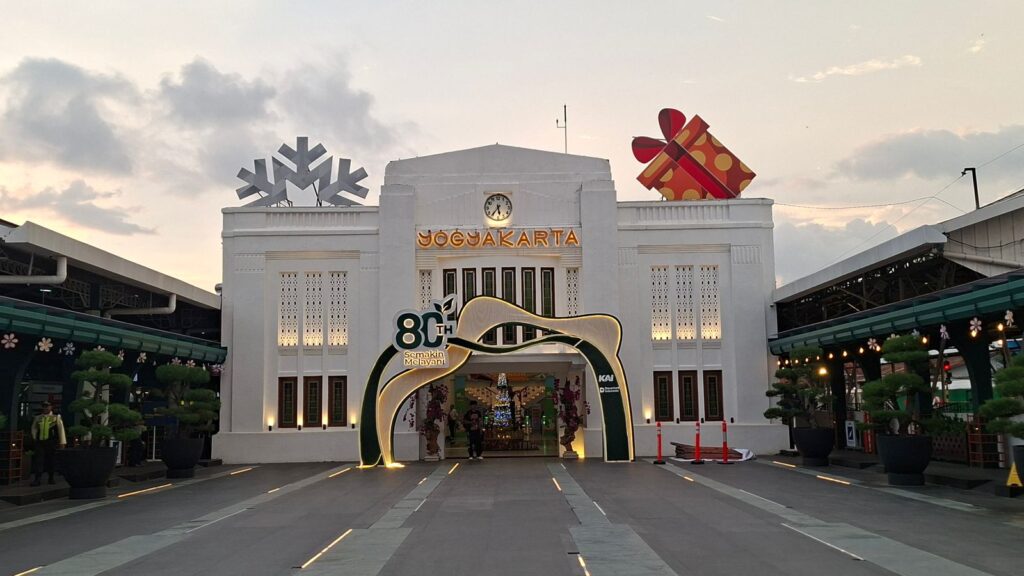
Malioboro Street officially begins (or ends, depending on your perspective) at Yogyakarta Station, also known as Yogyakarta Tugu Station (code: YK). This is the city’s main railway station and one of the most important transport hubs in Central Java.
The station’s location at the northern end of Malioboro isn’t coincidental. When Sultan Hamengkubuwono I laid out the Cosmological Axis, the area where the station now stands marked the boundary between the sacred inner city and the outer world. The Tugu Monument, visible from the station, represents this transition point.
For travelers arriving in Yogyakarta by train, stepping out of the station directly onto Malioboro creates a powerful first impression. You immediately see the street stretching south, vendors on both sides, becak drivers offering rides, and in the far distance, the area where the Kraton sits.
The station area has several hotels, restaurants, and shops catering to travelers. It’s a practical starting point for exploring Malioboro, as you can walk the entire 1.5 kilometer length of the street, experiencing how it changes from commercial tourism at the north end to more cultural and historical significance as you approach the Kraton area in the south.
If you’re interested in learning more about the station itself and train travel in Yogyakarta, you can read our detailed guide at Borobudur Sunrise.
Practical Information for Visiting Malioboro Street
How to Get There
Malioboro is in the absolute center of Yogyakarta, making it easy to reach from anywhere in the city.
From the airport (YIA), take the Damri bus to Malioboro (costs about 35,000 IDR), use Grab or Gojek ride sharing apps (about 150,000 to 200,000 IDR depending on traffic), or book a private airport transfer.
If you’re staying elsewhere in Yogyakarta, the Trans Jogja bus system stops at multiple points along Malioboro. A ride costs 3,500 IDR. Grab and Gojek are also widely available and cheap for getting around the city.
Many tourists simply walk to Malioboro from their hotels, as most accommodation in central Yogyakarta is within 10 to 20 minutes on foot.
Best Time to Visit
For shopping and experiencing the full energy of Malioboro, visit in the late afternoon or early evening (4:00 PM to 8:00 PM). The weather is cooler, both shops and street vendors are open, and the lesehan food culture is in full swing.
For photos without crowds, come early morning (6:00 AM to 8:00 AM) before most shops open and tour groups arrive.
To see Malioboro at its most atmospheric, visit on weekend evenings when locals come out in force. The street feels more alive, more authentically Jogja.
What to Bring
- Cash (most street vendors and small shops don’t accept cards)
- Comfortable walking shoes (you’ll be on your feet for hours)
- Small backpack or bag (easier than carrying multiple shopping bags)
- Sunscreen and hat (daytime visits can be brutal under the tropical sun)
- Water bottle (stay hydrated while shopping)
- Phone or camera (but keep it secure in crowded areas)
Safety Tips
Malioboro is generally safe, but like any busy tourist area, pickpockets operate here. Keep valuables secure. Don’t carry your phone in your back pocket. Wear bags in front of you in very crowded areas.
Be aware of common scams: unofficial “guides” who offer to show you around then demand payment, becak drivers who quote one price then charge another at the end, and vendors who claim their batik is hand made when it’s clearly printed.
That said, most people on Malioboro are genuinely friendly and honest. Don’t let paranoia ruin your experience. Just use basic common sense.
How Long to Spend
You could walk the entire length of Malioboro in 20 minutes if you didn’t stop. But that would be missing the point entirely.
Plan for at least 2 to 3 hours to experience Malioboro properly. That gives you time to browse shops, bargain for souvenirs, stop for food, soak in the atmosphere, and maybe explore Beringharjo Market.
If you want to include Masjid Gedhe and a proper visit to the Kraton area, allocate a full half day (4 to 5 hours) or even a full day.
Many visitors return to Malioboro multiple times during their Yogyakarta trip. Once during the day for shopping, once in the evening for food and atmosphere, once more for last minute souvenir buying before leaving the city.
Wrap Up
So, is Malioboro Street worth visiting? If you’re in Yogyakarta, it’s not really a question. Malioboro is the heart of the city. Skipping it would be like visiting Paris and avoiding the Eiffel Tower area. Sure, you can, but why would you?
Come for the batik shopping and street food. That’s the surface level, and it’s genuinely Most visitors to Yogyakarta spend at least some time on Malioboro. The smart ones spend enough time to understand what they’re actually experiencing. Be one of the smart ones.
Read also : Borobudur Ticket Price
Read also : Ramayana Ballet Prambanan
Read also : Timang Beach and Gondola Ride
Read also : A complete guide of Jomblang Cave
Read also : A complete guide of Pindul Cave
Read also : Prambanan Temple Entrance Fees
Read also : How to go from Semarang Port to Borobudur