Every great temple has a story behind it. Borobudur has the journey toward enlightenment, carved in stone across two kilometers of relief panels. Prambanan has something different: a love story gone wrong, a curse spoken in fury, and a princess frozen in stone for eternity.
That story is the Legend of Roro Jonggrang, and it is the reason Prambanan Temple exists at all. For over a thousand years it has been told and retold across Java, passed down through generations as one of the most dramatic myths in Indonesian culture. And since 2026, it has been performed every Friday night inside the Trimurti Theatre at the Prambanan complex as a full ballet production, combining classical Javanese dance, dramatic acrobatics, and modern multimedia staging into a show that is as visually extraordinary as the temple it is named after.
This guide covers the full legend in detail, what to expect from the performance, the show schedule, ticket prices, and how to combine it with a Prambanan sunset visit for a complete evening that does justice to one of the greatest sites in Southeast Asia.
Before we continue to the main topics, please consider BorobudurSunrise.com if you need tour package in Yogyakarta City. We have an excellent review by Trip Advisor or by Viator. You may check our tour package in this link : Yogyakarta Tour or MountBromoIjen.com. You can also send us an email at [email protected] or just simply contact us by pressing the whatsapp button in the right corner.
The Full Legend of Roro Jonggrang
The story begins with two kingdoms, a defeat, and a father’s grief.
King Damarmoyo ruled a powerful kingdom in ancient Java. His rival, King Boko, challenged him to war and won. King Damarmoyo was defeated, his pride broken, his kingdom diminished. In his grief, he called his son Bandung Bondowoso to his side and poured out his anguish. Bandung, burning with filial loyalty and the particular rage that comes from seeing a parent humiliated, vowed revenge.
He challenged King Boko to battle. The confrontation was fierce, but Bandung was younger, stronger, and fighting with the fury of a son defending his father’s honor. King Boko fell in the battle.
Then something happened that the legend turns on. In the aftermath of his victory, Bandung entered the defeated king’s palace and saw Roro Jonggrang, King Boko’s daughter. She was, by every account the story preserves, of extraordinary beauty, and Bandung fell in love with her immediately and completely. The man who had just killed her father looked at the daughter and saw only the woman he wanted to spend his life with.
He proposed marriage.
Roro Jonggrang’s position was impossible. She was the daughter of the man this warrior had just killed. She was consumed with grief and rage. She could not accept the man who stood before her, regardless of his obvious sincerity or his very considerable power. But refusing outright a man of Bandung’s strength and temper carried its own dangers.
So she set a condition she believed was impossible.
If Bandung Bondowoso truly wished to marry her, he must build one thousand temples in a single night, completed before the first rooster crowed at dawn.
It was a way out disguised as a challenge, and she was certain no mortal man could achieve it. What she had not fully accounted for was that Bandung was not entirely a mortal man in the ordinary sense. He commanded supernatural forces, armies of spirits and djinn who answered his call. He accepted her condition without hesitation and summoned his supernatural army to begin.
Through the night the spirits worked at impossible speed. Temples rose from the ground one after another across the plains of Prambanan. As the hours passed and the count climbed toward a thousand, Roro Jonggrang watched from the palace with growing dread. He was going to do it. The impossible was being accomplished before her eyes.
She had no intention of honoring her promise.
In desperation, she woke the women of the village and instructed them to pound rice, the traditional morning task that signaled the start of a new day. She ordered others to light fires in the east, creating the glow of a false dawn on the horizon. Roosters, responding to the light and the activity as roosters do, began to crow.
The spirits, believing dawn had genuinely arrived, fled. They could not work in daylight. They abandoned their construction before the thousandth temple was complete.
Bandung walked among the temples and counted. Nine hundred and ninety-nine. One short.
When he discovered what Roro Jonggrang had done, the betrayal cracked something open in him. He had offered her something real. He had summoned forces beyond ordinary human capacity to fulfill her condition in good faith. And she had tricked him with a false dawn.
His rage, when it came, was absolute. He cursed Roro Jonggrang with a fury that the legend says shook the ground beneath Prambanan. He turned her to stone, completing the thousandth temple himself with the curse that transformed the princess into the final statue. Roro Jonggrang stands to this day inside Prambanan’s main shrine, immortalized in stone as the statue of Durga in the northern chamber of the Shiva temple, her beauty preserved forever and her fate sealed by the depth of the deception she chose.
The love that Bandung felt did not disappear when he cursed her. That is what the legend ultimately holds: the wound of betrayal is deepest when the love was real. What lives on at Prambanan is not just the architecture. It is the emotional residue of something that could not be resolved any other way.
The Roro Jonggrang Ballet Performance
The Legend of Roro Jonggrang is performed every Friday night at the Trimurti Indoor Theatre inside the Prambanan Temple complex. This is a dedicated production distinct from the more widely known Ramayana Ballet, and it brings a different energy and a different story to the Prambanan stage.
Where the Ramayana Ballet is an epic spanning multiple acts, broad in cast and sweeping in its narrative arc, the Roro Jonggrang Ballet is tighter and more intimate, focused on the emotional core of a single love story and its catastrophic ending. The production combines classical Javanese dance vocabulary with dramatic and acrobatic elements and a modern multimedia backdrop using a high-quality videotron screen that transforms the indoor stage into something genuinely spectacular. The visual scale of the production does not depend on the outdoor temple backdrop that the Ramayana uses during dry season performances. Instead, it creates its own visual world through choreography, lighting, and the interplay between live performance and digital scenography.
The performance runs from 19:30 to 20:30, a one-hour show with no intermission. It is more concentrated in duration than the Ramayana Ballet, which runs 90 minutes to two hours. For travelers who want a high-quality cultural performance without an extended evening commitment, or those combining it with a sunset Prambanan visit, the tighter runtime is genuinely practical.
The production is described in its own promotional material as Dramatic, Acrobatic, Interactive with Multimedia, and those three elements are genuinely present in the staging. The acrobatic sequences create moments of physical drama that punctuate the dance narrative. The interactive multimedia elements use the videotron backdrop to shift settings and atmosphere across the different chapters of the story. The dramatic core is the love story itself, told through movement and music in a way that requires no spoken language and is fully accessible to international visitors regardless of Indonesian language ability.
The music accompaniment uses high-quality recorded gamelan and orchestral scoring rather than a live ensemble. This distinguishes it from the Ramayana Ballet which features live gamelan performance, but the recording quality of the Roro Jonggrang production is consistently praised as atmospheric and appropriate to the emotional tone of the story.
Read also : Ramayana Ballet Prambanan
Roro Jonggrang Dance Show Schedule
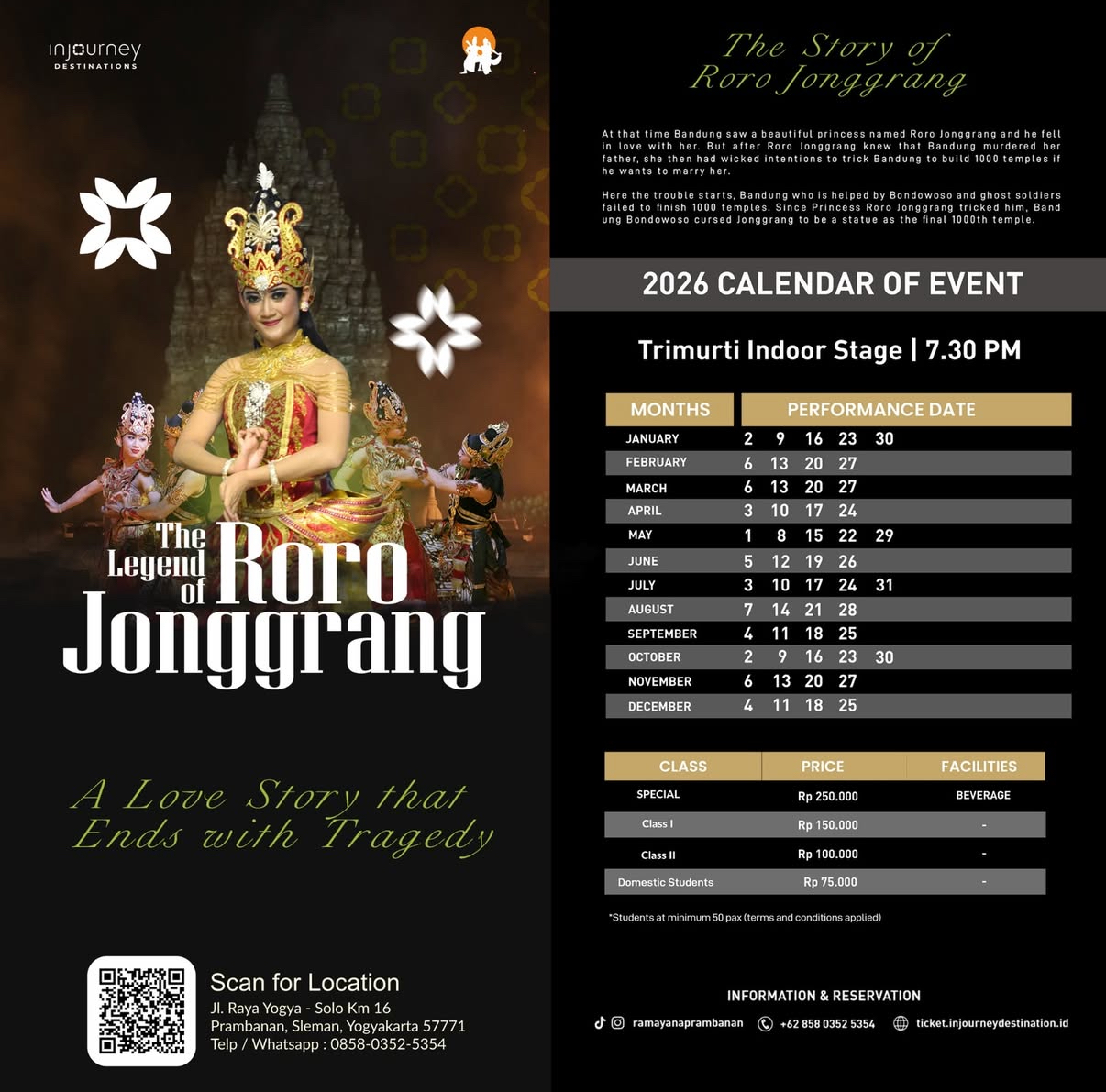
The Roro Jonggrang Ballet performs every Friday throughout the year, January to December 2026, at the Trimurti Indoor Theatre inside the Prambanan Temple complex.
Venue: Trimurti Indoor Theatre, Prambanan Temple Complex Schedule: Every Friday Showtime: 19:30 to 20:30 WIB (no intermission) Capacity: 378 seats, all with numbered seating
The indoor venue means the Roro Jonggrang Ballet runs regardless of weather, which is a significant practical advantage over outdoor performances that are subject to rain delays and cancellations. Unlike the Ramayana Ballet’s outdoor open stage which is only available during the dry season from May to October, the Roro Jonggrang Ballet performs year-round indoors with consistent quality and reliable timing.
The ticket box opens at 17:00 WIB. The gate opens at 18:30 WIB. All visitors are expected to be seated at least 5 minutes before the performance begins at 19:30.
Roro Jonggrang Show Ticket Prices
All seats at the Roro Jonggrang Ballet have assigned seat numbers, which means your specific seat is confirmed at the time of booking regardless of class.
Special Class: IDR 250,000 per person Numbered assigned seating plus complimentary soft drink.
1st Class: IDR 150,000 per person Numbered assigned seating.
2nd Class: IDR 100,000 per person Numbered assigned seating.
Children’s policy: Children aged 5 years and above are charged the full adult ticket price. Children under 5 years old are free of charge if seated on a parent’s lap. If a child under 5 occupies their own seat, the full adult ticket price applies.
Student rate (domestic groups only): IDR 75,000 per person for groups of minimum 50 participants with an official letter from a school or university. Not applicable for KITAS holders.
Important: The ticket price does not include the Prambanan Temple entrance fee, which must be purchased separately if you wish to visit the temple complex before the performance. The Prambanan entrance ticket costs IDR 400,000 for adults and IDR 250,000 for children aged 3 to 10 years, with the temple open from 06:30 to 17:00 through the East Entrance.
Tickets cannot be canceled and are non-refundable. Bringing outside food, beverages, or meals into the theatre is not permitted.
The Perfect Combination: Prambanan Sunset and Roro Jonggrang Ballet
The most rewarding way to experience the Roro Jonggrang story is not just to watch the ballet, but to arrive at Prambanan in the late afternoon and spend the time before the show inside the very temple complex the legend created.
Arrive at Prambanan by 4:00 PM. The entrance ticket covers access to both the main Prambanan complex and the nearby Sewu Temple compound. Spend the first hour exploring the temple grounds: the three main spires of Brahma, Vishnu, and Shiva rising to over 47 meters, the stone reliefs depicting scenes from the Ramayana carved across the lower gallery walls, and the northern chamber of the Shiva temple where the statue of Durga stands. That statue is Roro Jonggrang herself, according to the legend, frozen in stone for eternity by Bandung’s curse. Standing before it in the late afternoon, knowing the story, changes the experience of looking at it entirely.
As 5:00 PM approaches, find a position on the main temple lawn facing west. The sun descends toward the Menoreh Hills on the horizon and the light catches the stone spires in a way that turns them from grey to deep gold. Mount Merapi is visible in the distance to the north, its silhouette sharpening as the sky changes color. This is the golden hour at Prambanan, one of the most celebrated sunset views in all of Yogyakarta, and it happens while you are already inside the complex with your ticket for the evening performance already confirmed.
After the sunset light fades, around 17:30 to 18:00, make your way to the Roro Jonggrang performance area within the complex. The ticket box opens at 17:00. You have time to find your seat, settle in, and absorb the atmosphere of the Trimurti Theatre before the show begins at 19:30.
By 20:30 the performance is complete. You leave having watched the sun set over the very temples the legend describes and then watched the legend itself performed on stage. The full evening, from arrival for the sunset to departure after the ballet, is approximately four hours. It is one of the most complete and coherent cultural experiences available anywhere in Java: the physical site, the light, and the story that explains why the site exists, all in a single evening.
Read also : Prambanan Temple Ticket Information
Roro Jonggrang vs Ramayana Ballet: Which Should You Choose?
Both performances take place at the Prambanan complex. Both tell important stories from the Hindu cultural tradition that shaped this landscape. Understanding the difference helps you choose the right evening.
The Ramayana Ballet is the larger, longer production, running 90 minutes to two hours with a live gamelan orchestra. It tells the story of Prince Rama’s quest to rescue his wife Sita from the demon king Ravana, a sweeping epic with a large cast and dramatic battle sequences. During dry season (May to October), it performs on the outdoor open stage with Prambanan’s three main spires as the live backdrop, one of the most spectacular theatrical settings in Southeast Asia. It runs on Tuesday, Thursday, and Saturday evenings.
The Roro Jonggrang Ballet is more intimate, one hour without intermission, with recorded music and modern multimedia staging. It tells the specific legend of Prambanan itself: the love story, the impossible condition, the betrayal, and the curse. It is more focused emotionally and more directly connected to the temple you are visiting. It runs on Friday evenings only, year-round, indoors.
For travelers who have one evening at Prambanan and want the most direct connection between the performance and the site, the Roro Jonggrang Ballet is the choice. For travelers who want the full scale of Javanese classical dance with live music and the outdoor temple backdrop during dry season, the Ramayana Ballet is the more expansive experience.
Many travelers who spend multiple evenings in Yogyakarta attend both.
Read also : Borobudur Temple Ticket
How to Book Roro Jonggrang Performance
The Roro Jonggrang Ballet can be booked through our Prambanan Ramayana Ballet package. Simply select a Friday date when booking and your ticket will be for the Roro Jonggrang Ballet performance rather than the Ramayana.
Our package includes private return transportation from your Yogyakarta hotel to the Prambanan complex and back, your performance ticket in your chosen seat class, and the option to combine with a Prambanan sunset temple visit and optional buffet dinner at the Rama Shinta Garden Resto near the complex, running from 17:00 to 19:30 for IDR 235,000 per adult and IDR 175,000 per child aged 3 to 10 years.
Browse and book all Prambanan performance packages here. When selecting your date, choose any Friday for the Roro Jonggrang Ballet.
Advance booking is strongly recommended. The Trimurti Theatre holds only 378 seats, and Friday evenings fill quickly, particularly during peak season in July and August and over major holidays. Book at least one week ahead, and two weeks or more during peak travel periods.
Practical Information
Getting to Prambanan from Yogyakarta: The complex sits approximately 17 kilometers east of Yogyakarta city center, around 40 to 45 minutes by car. Our package includes hotel pickup and drop-off. Independent travelers can use Grab or Gojek from the city, or the Trans Jogja public bus on line 1A for IDR 3,500.
What to wear: Smart casual dress is appropriate. The Trimurti Theatre is air-conditioned indoors, so a light layer is recommended for the performance itself, particularly if you have spent the afternoon in the heat of the temple grounds.
Cameras and phones: Photography is generally permitted. Flash photography during the performance disrupts other audience members and should be avoided. Check with theatre staff on arrival for the current policy as it can change between seasons.
Arriving late: All visitors are expected to be seated at least 5 minutes before the 19:30 start. Late arrivals may be asked to wait until a suitable break in the performance before being shown to their seats. The show runs without intermission, so plan your arrival accordingly.
Final Thoughts
Prambanan is extraordinary in daylight. At sunset it is extraordinary and golden. And when the legend that created it is performed on stage fifty meters from the temple it inspired, watched by an audience that has just watched the sun go down over those same stone spires, the whole experience becomes something genuinely layered and memorable in a way that a standard daytime temple visit never quite achieves.
The story of Roro Jonggrang is a story about love, pride, betrayal, and consequence. It is also the story of why Prambanan looks exactly the way it does: a thousand temples built in a single night by a man whose fury at betrayal became the monument that outlasted him by a thousand years.
Come for the sunset. Stay for the story.
Book your Friday evening Roro Jonggrang Ballet package here.
Read also : Sewu Temple Complete Guide
Read also : Ratu Boko Complete Guide
Read also : Borobudur Sunset Complete Information
Read also : Jakarta to Yogyakarta by Train